
.png)
Strawberry Data Information: What Is StrawberryData and How Does It Work?
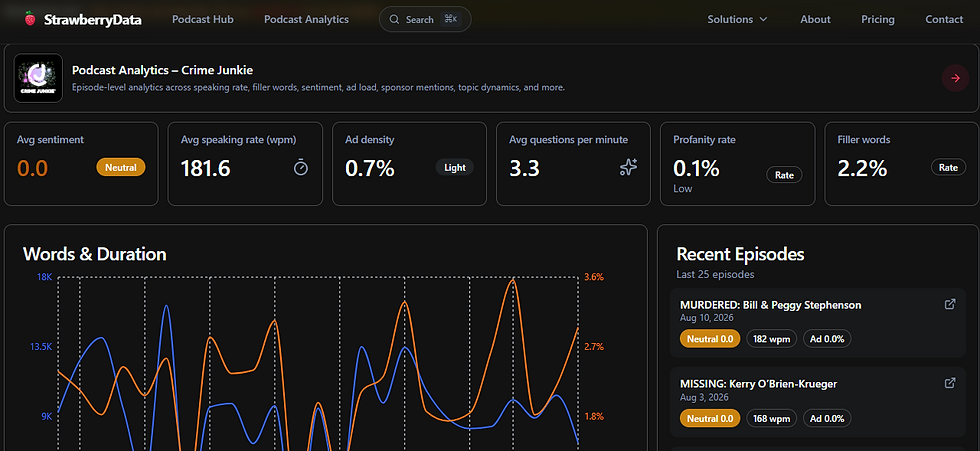
In a world where podcasts generate millions of minutes of audio every day, finding useful information inside that content can be difficult. Strawberry Data Information refers to the type of structured intelligence that can be extracted from podcast content through platforms such as StrawberryData. StrawberryData is a podcast intelligence platform designed to transform large amounts of unstructured audio into searchable and comparable information. According to the company, its technology analyzes podcast content to identify topics, keywords, sentiment, narratives, patterns, and other signals that can help businesses, creators, agencies, journalists, and researchers understand what is being discussed across podcasts.
What Is StrawberryData?
StrawberryData is a platform focused on podcast analytics and intelligence. Rather than requiring users to listen to hours of individual episodes, the platform processes podcast content and turns it into structured information that can be analyzed. The company describes its platform as a way to aggregate high-signal content from podcast sources and transform it into comparable, queryable metrics. Its stated applications include monitoring narratives, benchmarking competitors, evaluating brand suitability, and identifying changes in conversations more quickly. This makes StrawberryData different from a traditional podcast directory. Its purpose is not simply to help people discover podcasts, but to help users understand the information contained within them.
What Kind of Information Does StrawberryData Provide?
Podcast episodes contain much more information than their titles and descriptions. Audio can include discussions about brands, industries, products, trends, public figures, consumer behavior, and emerging topics. StrawberryData says it can extract several types of signals, including:
Topics discussed during episodes
Keywords and important terms
Sentiment indicators
Narratives and conversation patterns
Sponsor and advertising information
Ad density
Language-related signals
Episode summaries and transcripts
Comparative podcast analytics
The platform's press information states that it processes thousands of episodes and provides more than 10 enriched fields per episode, although coverage and update frequency can vary by show.
Why Is Podcast Data Becoming More Important?
Podcasts have become an important source of long-form conversations. Unlike short social media posts, podcast episodes can contain extended discussions that provide context around a topic. For businesses and researchers, this creates an opportunity to identify patterns that might otherwise require significant amounts of manual listening and analysis. For example, a company could potentially use podcast intelligence to investigate:
How frequently its brand is being discussed
What subjects are associated with its industry
How competitors are appearing in conversations
What topics are gaining attention
Where potential sponsorship opportunities may exist
How advertising is distributed across shows
Instead of treating every podcast episode as an isolated piece of content, structured data allows users to compare information across multiple episodes and shows.
How Businesses Can Use Strawberry Data Information
One potential application is competitive intelligence. A marketing team could examine podcast conversations surrounding competitors and identify recurring topics, product discussions, or industry narratives. This information could complement other sources of market research.
Another application is brand suitability. Companies investing in podcast advertising need to understand the type of content and conversations associated with particular shows. Podcast analytics can provide additional information when evaluating potential partnerships. Agencies and creators can also use structured podcast information to identify relevant conversations and potential opportunities. StrawberryData specifically positions its platform for businesses, creators, agencies, journalists, and researchers.
Is StrawberryData the Same as AI?
Not exactly. StrawberryData uses AI-driven analysis to process podcast content, but the platform itself is better understood as a podcast intelligence and analytics service. The distinction matters because the goal is not simply to generate an AI response. The platform organizes information from podcast content into metrics, summaries, transcripts, topics, and other signals that users can analyze. The resulting data can then support research, reporting, marketing decisions, media analysis, and other workflows.
What Are the Limitations?
Podcast analytics should not automatically be treated as absolute truth. StrawberryData itself notes that its analytics are directional signals rather than definitive facts. Machine-generated analysis can miss context or nuance, while transcription can introduce errors. This is an important consideration for anyone using podcast data for research or business decisions. For example, sentiment analysis may not fully understand sarcasm, humor, cultural references, or complicated opinions. Similarly, an automated transcript may contain errors that affect keyword or topic analysis. Human review therefore remains important when the information is being used for significant decisions.
Strawberry Data Information in the Bigger Data Landscape
The growth of tools such as StrawberryData reflects a broader shift in how organizations work with information. Data is no longer limited to spreadsheets, databases, and traditional reports. Increasingly, valuable information can be found inside audio, video, social media, documents, and other unstructured sources. The challenge is turning that information into something searchable and useful. Podcast intelligence platforms attempt to solve part of that problem by converting conversations into structured signals that can be compared and analyzed.
Final Thoughts
Strawberry Data Information can be understood as structured intelligence extracted from podcast content, particularly through the StrawberryData platform. For businesses, marketers, researchers, agencies, and media professionals, the value comes from reducing the amount of manual work required to understand large volumes of podcast content.
As podcasts continue to generate extensive amounts of long-form information, tools that can organize, analyze, and compare that content may become increasingly useful. At the same time, users should remember that automated analytics are signals rather than perfect representations of what was said. The combination of AI-powered analysis and human verification is likely to remain important as organizations look for better ways to turn unstructured content into actionable information.



Comments