
.png)
Canon EOS R8 Mark II Review: New IBIS, Faster Shooting and a Tough Nikon Rival
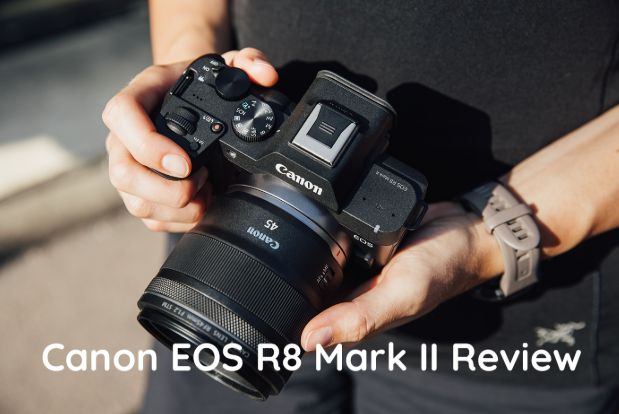
Canon has given its entry-level full-frame mirrorless lineup a significant refresh with the new Canon EOS R8 Mark II. While the camera keeps the familiar 24.2-megapixel full-frame sensor from the original EOS R8, Canon has addressed several of the biggest limitations of its predecessor, including the lack of in-body image stabilization and a physical autofocus joystick. The result is a lightweight full-frame camera that feels considerably more complete. However, at a launch price of $1,899 for the body, the EOS R8 Mark II enters a market where Nikon's Z5 II offers some compelling advantages of its own.
A New Look for the EOS R8
The EOS R8 Mark II gets a redesigned body with sharper, flatter surfaces inspired by Canon's older camera designs. Despite the updated appearance, the focus remains on portability. At approximately 546 grams with its battery and memory card, Canon describes it as the lightest EOS camera equipped with in-body image stabilization.
The new multi-controller joystick is another welcome addition. It gives photographers a more direct way to move the autofocus point, making the camera more practical for subjects that require precise focus positioning.
For photographers upgrading from the original R8, these changes make the Mark II feel more like a complete enthusiast camera rather than simply a cosmetic refresh.
IBIS Is the Biggest Upgrade
The most important hardware improvement is arguably the addition of in-body image stabilization (IBIS). Canon rates the stabilization system at up to 7.5 stops at the center of the image when used with compatible stabilized lenses, with up to 7 stops toward the periphery under Canon's specified testing conditions. This is particularly useful for handheld photography in low-light environments. It can also make shooting with non-stabilized lenses considerably easier, especially when traveling or working in situations where carrying a tripod isn't practical. The original EOS R8 did not have sensor-shift stabilization, so this represents a substantial functional improvement rather than a minor specification change.
Fast Autofocus and 40fps Shooting
Canon has also continued to emphasize autofocus performance. The EOS R8 Mark II uses Dual Pixel CMOS AF II with subject detection for people, animals and vehicles. Canon also includes a People Priority function that can register specific people for autofocus recognition. For action photography, the camera can reach up to 40 frames per second using its electronic shutter. It also adds pre-continuous shooting, allowing approximately half a second of images to be captured before the shutter button is fully pressed.
That combination could be useful for photographing unpredictable moments, from sports and wildlife to children and fast-moving street scenes. The camera can also record up to 73 RAW images continuously at 40fps under Canon's specified conditions, while Canon says continuous RAW and JPEG capacity has increased compared with the original R8.
Video Gets a Boost Too
The EOS R8 Mark II isn't only aimed at photographers. It offers full-width 4K video from 6K capture at up to 60fps, while Full HD recording can reach 180fps for slow-motion footage. Canon has also added new color and creative options, giving creators more flexibility when producing content directly from the camera. For hybrid shooters, vloggers and travel creators, the combination of a full-frame sensor, compact body, IBIS and strong autofocus makes the R8 Mark II an interesting all-purpose option. There are still compromises, though. The camera has a single SD card slot, a relatively small LP-E17 battery and no built-in cooling fan. Canon's specifications also rate battery life at between 150 and 340 shots depending on shooting conditions and display settings.
The Nikon Z5 II Problem
The biggest challenge for the Canon EOS R8 Mark II may not come from Canon's own lineup but from Nikon's Z5 II. The two cameras are positioned similarly, with both using approximately 24-megapixel full-frame sensors and offering image stabilization. However, the Nikon includes features that can make the purchasing decision difficult for photographers who aren't already committed to a particular lens system.
The Z5 II has dual SD card slots, a more robust weather-resistant body, higher-specification displays and longer battery life. It also supports internal 12-bit RAW video, giving Nikon an advantage for creators who prioritize advanced video workflows. Canon counters with its lightweight design, 40fps electronic burst shooting and its autofocus system, while the RF lens ecosystem gives existing Canon users an easier upgrade path. The pricing also puts the cameras close together. Canon lists the EOS R8 Mark II at $1,899 body-only, while the Nikon Z5 II launched at around $1,850.
Is the Canon EOS R8 Mark II Worth Considering?
The EOS R8 Mark II feels like a meaningful evolution of the original R8 rather than a simple specification update. Adding IBIS, a joystick, improved autofocus functionality, faster continuous shooting and video improvements addresses several areas where the first-generation camera fell short. The lightweight 546-gram body also makes it attractive for travel photographers and creators who don't want to carry a heavier professional camera. But the competition is much tougher now.
Nikon's Z5 II offers a more feature-rich body in several areas, including dual card slots, stronger battery performance and internal RAW video. For photographers choosing their first full-frame system, those differences deserve serious consideration. For existing Canon users, however, the decision can look different. The EOS R8 Mark II combines the familiar Canon shooting experience with a much more capable body, while maintaining access to Canon's RF lens ecosystem.
The Canon EOS R8 Mark II therefore looks less like a revolutionary new camera and more like the EOS R8 finally becoming the camera it always had the potential to be. Its biggest question isn't whether it improves on the R8 — it clearly does — but whether those improvements are enough to stand out in an increasingly competitive full-frame market. Canon says the EOS R8 Mark II is scheduled to become available in October 2026, with U.S. pricing starting at $1,899 for the body and $2,099 with the RF24-50mm lens.



Comments